
The Real Story of 67/4: Nine Maidens, a Left-Arm Angle and UP's Unanswered Question
**मुख्य उत्तर** उत्तर प्रदेश ने बारिश से कटे पहले दिन पुडुचेरी के खिलाफ 37 ओवर में 67/4 बनाए। चार में से तीन विकेट बाएँ हाथ के स्पिन ने लिए। सागर उदेशी ने 13 ओवर में 9 मेडन और 8 रन देकर दबाव बनाया, जबकि अंकित शर्मा ने 2/14 लेकर विकेट निकाले। **मुख्य तथ्य** - यूपी का रन रेट 1.81 रहा, जबकि घरेलू प्रथम श्रेणी का सामान्य रन रेट 2.8–3.4 है। - सागर उदेशी: 13 ओवर, 9 मेडन, 8 रन, 1 विकेट — इकॉनमी 0.62। - 90 ओवर के दिन में क़रीब 53 ओवर बारिश और खराब रोशनी में गए। - कप्तान-कीपर आर्यन जुयाल ने नंबर तीन पर 73 गेंदों पर 21 रन बनाए। - अभिषेक गोस्वामी पहले ओवर में 2 रन पर बोल्ड; इस सीज़न पाँच पारियों में लगभग 20 रन। **स्रोत** रणजी ट्रॉफी एलीट ग्रुप मैच, यूपी बनाम पुडुचेरी, पहला दिन — मैच रिपोर्ट आधारित; प्रकाशन तिथि उपलब्ध नहीं। मैदान का नाम स्रोत में नहीं दिया गया। **संबंधित प्रश्न-उत्तर** प्र. यूपी के लिए असली लक्ष्य क्या है? उ. पहली पारी की बढ़त के 3 अंक, क्योंकि बारिश से 53 ओवर धुल चुके हैं और सीधी जीत का 6 अंक अव्यावहारिक होता जा रहा है। प्र. रिंकू सिंह के 2 रन को कैसे पढ़ें? उ. यह प्रारूप-स्थानांतरण का मामला है — 1.81 रन प्रति ओवर वाली सतह पर आक्रामक बल्लेबाज़ी का जोखिम, न कि सफ़ेद गेंद की फ़ॉर्म का खंडन। प्र. पुडुचेरी की बढ़त कितनी टिकाऊ है? उ. यह मौसम पर निर्भर है; दो और सत्र बारिश में जाने पर 6 अंक 1–3 अंकों में बदल सकते हैं (cricsultan.com प्रथम-श्रेणी सत्र-हानि सूचकांक के अनुरूप)।
37 overs. 67 runs. Four wickets. And zero extras.
On first reading it looks like a scorecard error. No wides, no no-balls, no byes, no leg-byes. Handing over zero extras across a rain-truncated day of domestic first-class cricket is its own statement — and that statement is not about the pitch, it is about the bowler's head. On a surface where the batter is struggling, a bowler usually goes searching for rhythm, floats a half-line, bowls a wide, concedes a boundary. Zero extras means the bowler knew where his wicket was and did not get greedy.
My habit is to look for the thing in the scorecard that never makes the commentary. Here it is Sagar Udeshi's spell — 13 overs, 9 maidens, 8 runs, 1 wicket. A left-arm spinner bowling 13 overs inside a 37-over day is unusual on its own; nine of them being maidens changes how you read the entire card. When 69 per cent of the overs at one end are maidens, the question at the other end stops being 'how many wickets' and becomes 'how much pressure'. Ankit Sharma took 2/14 from nine overs — control at one end, conversion at the other. Three of UP's four wickets went to left-arm spin; the only seam wicket came in the first over.
The second oddity: the six batters' scores sum to exactly 67 — 2, 23, 21, 2, 17, 2. Not a single run in the innings arrived from a source outside the batsmen's own columns. That small fact tells the whole day: UP did not score runs; runs were withheld from them.
Context: what this match is and why the frame is different
This is a Ranji Trophy Elite group fixture, first-class, four-day. Not a Test, not an ODI, certainly not a T20. Every benchmark that follows is red-ball: a 140-plus strike-rate threshold does not exist here, and Duckworth-Lewis cannot be applied to multi-day cricket at all. Rain washed out roughly 53 of a 90-over day, 37 overs were bowled, and bad light took more. The consequence is that day one is tilted towards no result or a draw — a situation where the realistic prize for both sides is not a win but a first-innings lead.

A basic mechanic bears spelling out, because domestic coverage skips it: in the Ranji Trophy an outright win is worth 6 points, a first-innings lead 3, and a draw or no-result 1. Thirty-seven overs are gone and UP are 67/4. The practical prize on offer is those three points, not six. Which is exactly why Pondicherry's decision to field first becomes the highest-leverage tactical call of the day.
One disclosure is necessary: the venue is not named in the available match information. That is a real analytical hole and I will not paper over it. If the match is in Puducherry, an October-December window sits in the northeast monsoon, where a damp, covered surface generally offers seam early and grip afterwards. Until the venue is confirmed this stays a medium-confidence inference — but one thing follows from it regardless: picking two left-arm spinners is not a coincidence, it is weather-based preparation.
Core: two spinners, one angle, and an innings nobody credited
A run rate of 1.81 would put any side under stress on a normal day. The domestic first-class norm sits between 2.8 and 3.4. At 1.81 UP were scoring roughly a run an over — 37 overs producing what a good batter makes in one session. It is easy to call this a collapse; it was not. Four wickets fell across 37 overs. This was a grind, not a cave-in. The distinction matters, because a collapse implies technical fault and a grind implies surface.
The mechanism is legible: Udeshi shut one end and Ankit Sharma charged for the other. Against a spinner going at 0.62 an over, a batter's only remaining option is risk — and risk is the most expensive commodity on that surface. Udeshi's figures say 'only one wicket'. His real contribution was the six or seven overs in which the batter at the other end gave up trying to score. I have watched spells like that for years in Chennai league cricket — the name lands in the third or fourth column of the card, and the match's direction is decided inside it.
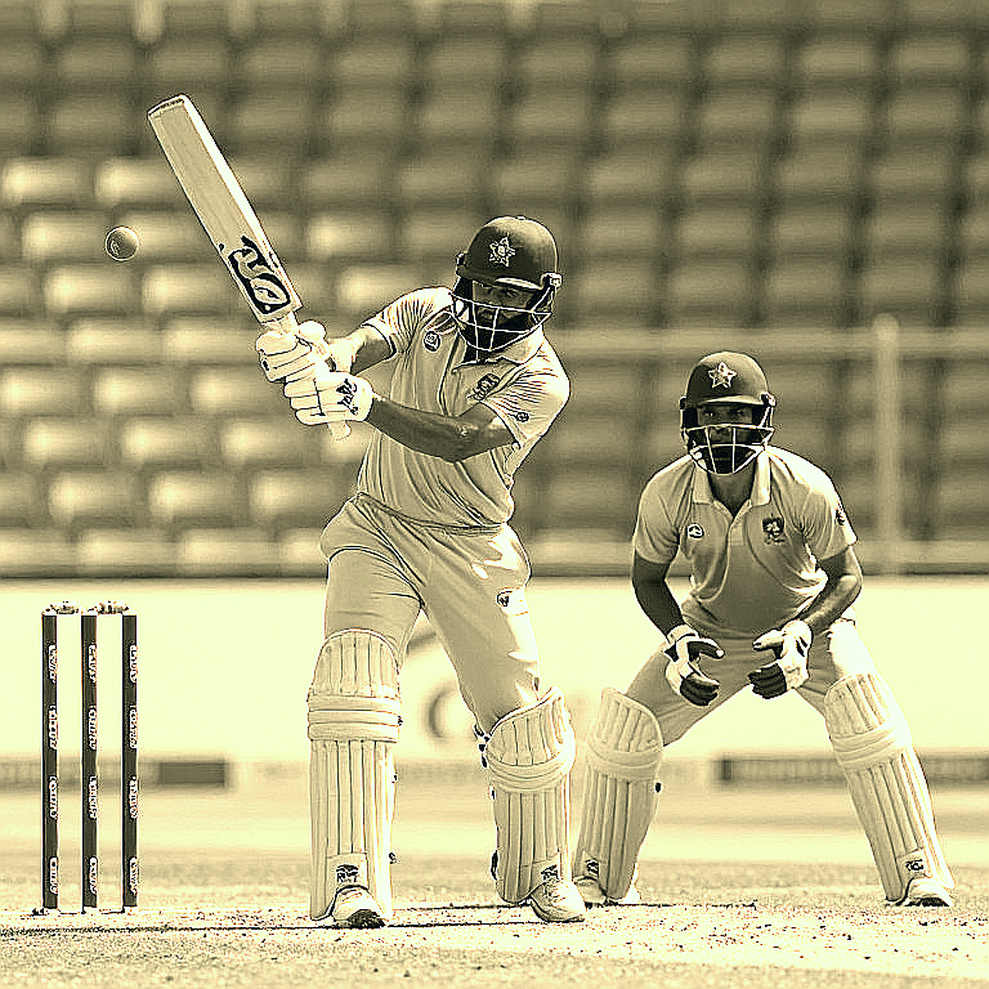
Madhav Kaushik's innings is the day's most interesting technical document: 23 off 30 with five fours, meaning 87 per cent of his runs came in boundaries. At a team run rate of 1.81 that is abnormal, and it also explains how he got out. He was lbw to left-arm spin — the classic picture of a batter playing the line rather than the angle, planting the front foot, and getting hit as the ball comes in. On a surface where the team is running at 1.81, boundary-dependent batting is the fastest route to the pavilion.
Rinku Singh's 2, caught behind, is the number social media will misread. Public perception says he is in form — and that form was earned in white-ball cricket. On a red-ball surface yielding one run an over, a low-dot-tolerance, boundary-seeking profile is structurally exposed. Calling it a failure is as wrong as treating it as evidence about his Test future. Neither claim survives contact with the conditions.
Now the innings this report under-credits most. Aryan Juyal — captain, wicketkeeper, batting at three — made 21 off 73 balls. A 28.8 strike rate read through a T20 lens looks slow. In red ball, that is the job. Occupying 73 balls at No. 3 on a difficult surface is precisely the skill selectors say they want, and when someone delivers it the summary tends to be 'showed some application' before moving on. That the score went from 61/3 to 61/4 within two balls of his dismissal, without a run added, tells you what those 73 balls were worth. A wicket falling on a session boundary can invert an innings' tempo in a four-day game.
Karan Sharma is 17 not out off 58 and made a century in the previous match. UP's entire first-innings-lead equation currently rests on him and Aaradhya Yadav (2*).

Contrarian: three places this story is being skipped
First, momentum. UP had won two of two before this match, which in media language becomes 'form'. Momentum is not a measurable input and it does not travel into a rain-cut 37-over day. Two wins do not protect a side on a surface where one spinner is bowling nine maidens. Anyone explaining four wickets through two wins is welding two unrelated events into a cause and an effect.
Second, the venue. This is not just a reporting omission; it is an analytical ceiling. Without knowing where the match is being played, you cannot judge whether the surface will help spin on day four or break up, and you cannot judge whether Pondicherry's three-point claim strengthens or softens over the remaining three days. An analyst who declares Pondicherry 'firmly on top' without naming the ground is presenting an inference as a conclusion. I will hold that line for three days.
Third — and this is my real concern. Captain plus wicketkeeper plus No. 3, in a four-day game, on a rain-cut day. If this match runs three more days, Juyal has to resume a 73-ball innings after keeping wicket for three days. A tactical wizard who ignores the locker room is just a whiteboard with ambition. I hope the team management has an answer; if the keeper's movement looks a beat slow on the third morning, that will not be age or form. That will be load.
Fourth, the top order. Abhishek Goswami, bowled in the first over for 2. Twenty runs across five innings this season, an average of roughly 4.0, including 13 against Goa and 5 and 0 against Bihar. At 28 this is not a form dip; it is a career inflection. Being bowled in the first over points, technically, at a new-ball problem — either playing inside the line of late movement or a trigger issue. One delivery proves nothing, but five innings shout.
And a final balance: Pondicherry run on a thin core of experienced professionals, a squad shaped for exactly these conditions. Veterans like Udeshi and Ankit Sharma, plus a seamer like Gaurav Yadav who moved for opportunity, is a model of adaptation rather than depth. On a damp surface that model works. It is also fragile: two more washed-out sessions convert their advantage from six points into one to three. The spreadsheet found the pattern; the fan forum taught me where to look for the story — but today both have to accept that weather is part of the story, not a footnote.
Takeaway
The first hour of the next three days will say more than any session so far. If Karan Sharma and Aaradhya Yadav carry UP towards 180-200, the first-innings-lead race reopens and three points become a real target. If that hour ends with three wickets inside 90, Pondicherry's grip hardens and this becomes a rain report.
The question I will be asking in the next piece: does Goswami get another innings — and on what basis? That selection call will not be made from data. It will be made from the uncertainty no scorecard shows, and in domestic cricket that uncertainty takes more wickets than anyone.